
Philipp Woite
Computational / Theoretical Chemist
Implementing physically motivated algorithms to investigate molecular systems.hummr.inp:
>> General
>> Basis def2-svp
>> End
>> CASSCF
>> NEl 23
>> NOrb 23
>> End
>> ImplicitSolvation
>> Solvent Water
>> End
--- Shell input ---
$ hummr hummr.inp 2>&1 hummr.out &
$ vis.py hummr.xyz -l hummr.cpcm
--- INTERACT WITH THE MOLECULE ---
PhD Thesis
Derivation and implementation of solvation model for strongly correlated systems.
Download thesis
Latest paper
Molecular Simulations to investigate the chain-growth dynamics of a TCC polymer.
Visit paper
HUMMR (Open Source)
Derivation and Implementation of solvation effects and their nuclear gradients.
Visit webpage
Timeline
Dr. rer. nat (Phd) (submitted)
Derivation and implementation of solvent effects on strongly correlated systems.
MSc in theoretical chemistry
Theoretical investigation of a Br(III) species and a biomimetic Cu-complex.
BSc in physical organical chemistry
Synthesis, measurement, and theoretical investigation of a bisimin in solution and Ar matrix.
Selected Other activity

Ehrenamt
2023-2025
As treasurer of the JCF-Berlin (the regional forum of the society of German chemists, GDCh), I took responsibility for finances, and nogotiated with local companies to win them as sponsors.
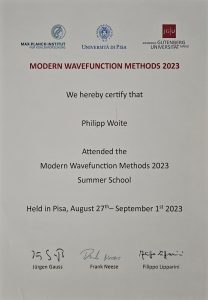
Summer School
2023
I took part in the MWM summer school (Modern Wavefunction Based Methods in Electronic Structure Theory) 2023 in Pisa, where I could deepen my knowledge and connect with students and professors from around the globe.
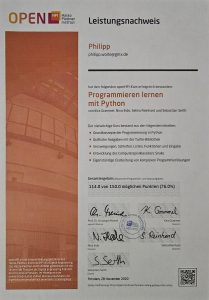
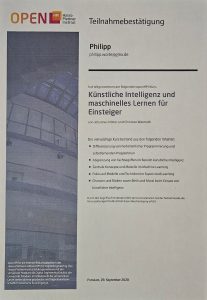
Additional certificates
By taking part in courses focused on Python programming and artificial intelligence and machine learning, I gained certificates certifying the successfull participation.

Teaching
2021-2026
In the winter semester, I compiled and conducted exercises with the aim to deepen and extend the knowledge conveyed in the lecture ‚Mathematische Grundlagen der Chemie‘ (mathematical principles of chemistry). Further I successfully supervised three theses.
Professional Experience
The (filled) circles indicate the skill level in this field. 5 stars for example indicate that every concept in that context is either known or readily understood. Concepts from fields with less stars might need more time to be learned.